Almost 2,000 years have passed since Jesus spoke the Great Commission. Thirty years ago, prayers for specific unreached peoples of the world began to rise up before the Father. Twenty years ago, videos and media campaigns about and for those unreached peoples began to circulate. Ten years ago, movements to Christ began to be reported among Hindu and Muslim peoples in Asia and Africa. Today, more than 115 million people have come to Christ in movements! That means a lot of new disciples on planet earth, and a lot more coming soon.
More than 1% of the eight billion people alive on earth today have come to Christ since the year 2000. And many movements are just getting started, with exponential growth in many regions. But most of these new believers do not have Bibles or discipleship materials in their mother tongue. They do not have leadership training or video teaching resources. Small groups are often growing into churches using a national or regional language, and the Gospel is being gossiped from house to house in thousands of mother tongues. House church networks are growing so fast that their leaders can barely keep up with all the new believers.
In 2015, Google initiated a project called “The Next Billion Internet Users.” Many of the people they identified are in the same places as the least-reached peoples of the world; in fact, the regions where movements are growing rapidly. David Garrison, author of A Wind in the House of Islam, has challenged Christian leaders to stop asking “What can we do?” and start asking, “What’s It Gonna Take?” Specifically for this article, “What’s it going to take to disciple one billion new believers?" Given present growth rates of movements in these most-populous parts of the world, we want to explore numerous possible answers to that question—especially answers to the needs identified by movement leaders themselves.
In early 2020, just days before COVID-19 shut down air travel worldwide, my team leader and I attended a gathering in Thailand of roughly 100 top movement leaders from around the world. There we met with three senior media leaders and presented them this challenge: “Jesus is winning tens of thousands of new believers across the nations. When are you, as media professionals, going to start serving all these new believers in these movements?” This electrified them, and the challenge pierced their hearts! For months, they had been discussing the seeming disconnect between movement leaders and media ministries. God had sovereignly placed the three of them (Calvin, Carol, and Grace) at this meeting to receive this new directive from the Lord through us.
After several months of deep discussions, fasting, and prayer during the COVID lockdowns, the idea for a new coalition called Media4Movements (M4M) began to take shape. Calvin, Carol, and Grace invited me to join the core leadership team of M4M. Our shared goal was to create a bridge, uniting the passion of movement leaders with the knowledge and skills of media, ethnoarts, Bible translation, technology, and orality experts.
Our M4M team has expanded, and we’ve witnessed valuable collaboration between movement leaders and media-ministry practitioners. Together, we are committed to provide support and come alongside movement leaders and their teams worldwide. We are not a new organization or a new program. We’re a bridge between the more established parts of the global Church and the new, highly mobile, multilingual house-church movements. We aim to bridge the gap from an older part of the global Church to its new emerging neighbors.
For several months, a core team listened to various needs of movements that could be supported by new Bibles, media, ethnoarts, or technology. An African leader told a story of a thousand Muslims standing in line to be baptized. A South Asian leader showed us rolls of butcher paper called “fruit charts,” mapping churches giving birth to churches, giving birth to more churches, like a giant mind map. Several Southeast Asia leaders said their groups had given birth to groups in eight, 10, even 15 generations, and had spread over a dozen language groups.
The needs varied greatly. They needed Scriptures. They needed training materials. Some leaders had too many teams in too many regions to adequately supervise them with direct onsite visits. They needed audio and video messages that could be passed down through provincial, county, and local leadership teams to new believers out on the growing edge of their movements.
As media leaders listened to the exciting progress happening in movements, we realized that we had very different experiences of how believer communities and daily life worked in formal churches and house-church networks. We saw that we needed to learn much more about each other’s lifestyles, language, and ministry culture in order to better understand one another.
Movement leaders didn’t necessarily know what questions to ask media experts. Urban videographers, rural ethnoarts specialists, and Bible translation intellectuals also came with different cultures and vocabularies. And the kind of rapid, on-the-fly expansion happening in movements meant any given ministry group we wanted to serve might be far away from the movement catalyst who had started the network.
God was releasing movements via godly people in many places, using methods and tools that were simple, reproducible, affordable, and multilingual. As we listened to movement leaders, a few key goals emerged.
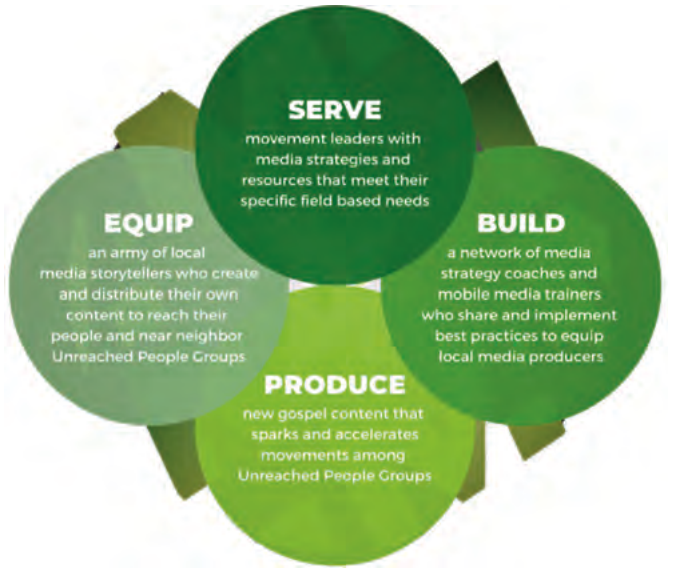
The M4M Coalition exists to:
- Serve movement leaders with media strategies and resources that meet their specific field-based needs;
- Equip an army of local media storytellers who create and distribute their own content to reach their people and nearby Unreached People Groups (UPGs);
- Build a network of media-strategy coaches and mobile-media trainers who share and implement best practices to equip local media producers;
- Produce new Gospel content that sparks and accelerates movements among UPGs.
That last part, of course, is not new at all. Media ministry is not new, and wonderful digital artists and tech-savvy people have used media within the existing Church for generations. For 50 years, global broadcast ministries have used radio and television for evangelism. In recent decades, evangelistic films and social media platforms have been used for outreach into many closed nations. And as God began to release movements in some regions, many of those ministries began intentionally seeking to follow up media contacts.
In early years, that follow-up looked like correspondence courses, but now interaction happens at social media speeds. Some visionaries have launched evangelistic media campaigns and sift through the thousands of contacts in order to funnel truly interested people out to teams on the ground for follow up. One version of this media strategy is called Media to Movements (MTM). These teams broadcast to millions to find the needle in the haystack who might want to believe in Jesus. Their audience is the vast world of not-yet believers, and they are looking for those few who are open to the Gospel.
The M4M coalition serves a very different audience: the tens of thousands of new believers. Movement leaders have “haystacks-high piles of needles”: mountains of new believers with very little access to Bibles, discipleship materials, or leadership training. The M4M audience is already following Jesus but often in messy house-church networks with minimal structure but lots of passion.
So while MTM is primarily focused on the lost and evangelism, M4M is focused on the newly-found and discipleship. Both need Bibles and culturally sensitive materials. God is answering prayers and opening large numbers of people to faith, now the global Church needs to help these believers grow and mature.
In God’s providence, the expanding, multigenerational movements we see today are happening during our digital era. Not only audio but also video recordings of Bible teaching, leadership training, and newly-created worship songs can be shared from home to home using phones and tablets. The huge new audiences of hundreds of thousands, even millions of new believers, can benefit from media created by movements and for movements. Local materials created in local languages by local people can address local problems most deeply.
Of course, once we focused on the problems that movement leaders face, we realized that many were already tackling these issues in simple, reproducible ways. Most movement leaders were already using messaging apps to track and train leaders across their networks. They used regional-language Bibles and wrote out key verses by hand, in local languages they knew.
We started to list some of the low-hanging fruit that could quickly be put into the hands of existing movement leaders: short segments of the Jesus Film, existing animation, and Bible portions. During our first year, we were able to provide short instructional media on how to use the phones they already had, particularly during the COVID-19 lockdowns. We identified examples of existing online media that might fit their context. A few teams shared tools for creating Bible apps from existing audio or text files. Some field teams were encouraged to share training or testimonies on their phones. A group of 20 very fruitful catalysts were coached for two months in principles of storytelling and soon realized that a shorter, clearer story saved them time in training and improved their impact. But the more we interacted, the more needs surfaced.
As travel restrictions eased, some teams ventured out into the field to serve specific movement leaders with specific skills they had requested. A team in Senegal did a training in smartphone film-making with several movement leaders, and within a week they were not only producing short videos but also training local networks in the same skills. A team in India brought their animations to a technology conference, and members of the M4M coalition learned how they could implement some new coaching training, using similar animation. A Bible translation team, using AI to shorten translation times, met with movement leaders to discuss possible translation projects for newly-won believers in Muslim communities. And an online forum shared parts of the following story with media experts from every continent.
In 2019, Wahid, a Muslim-background believer leading an expanding movement in Southeast Asia, was asked to follow up some media contacts in his region. Because he had small groups in almost every county of the province, his team could not only lead people to Christ using the local language, they could often connect them directly to a Bible study group for discipleship.
In 2022, Wahid sent out 10 teams of two to do media follow-up in several distant provinces. Not only did this penetrate several UPGs, it created a need for more discipleship materials. That same year, Wahid’s son Riki and a friend took an online course offered by an M4M coalition partner, and learned a lot about storytelling, video production, and distribution.
Their local media coach, mostly working with Christian-background believers and MTM, started helping M4M projects happen within the existing movement. Testimonies were recorded on audio. Short videos of Bible teaching and training were edited into small segments and distributed via phones and media players. Not unexpectedly, media created by people inside movements is often more effective than media brought into a region by outsiders. The outward-looking broadcasting and contact filtering of MTM, and the inward-focused discipleship of M4M within movements are working together seamlessly.
This fall, members of the M4M coalition are training several young men and women from Wahid’s team, and eight other teams, in smartphone film-making. Expert trainers from CREATE International’s media teams, who have done similar trainings in Africa, will be doing on-the-ground training in three different provinces. Riki and his partner will take the training to become trainers. Together, they will also help record new worship songs and key testimonies by movement leaders.
What will it take to disciple one billion new believers? It will take all the gifts of the Body of Christ. God is using apostolic leaders—specially-gifted movement catalysts—to break into whole new areas and ethnic groups. Among their first hundreds of believers God is raising up evangelists, pastors, and teachers. All of these gifted people plant simple house churches, centered on God’s Word—using tools that are simple, reproducible, affordable, and multi-lingual. Anything not simple, or too expensive, will not reproduce beyond the limits of the available resources. So the key to helping movement leaders serve up very-localized spiritual food at low cost is to model spiritual living and train skills into the upper levels of movements that can trickle downward across the networks. This is the way of Jesus movements. Two thousand years after the first such movements started, they are rapidly spreading again.
You can hear more M4M stories at www.GlobalMedia4Movements.com, and follow the growth of movements through the 24:14 Coalition at www.2414now.net.
Originally published in Mission Frontiers 46:1 (Jan/Feb 2024), pp. 40-43. Frontier Ventures. Shared with permission.